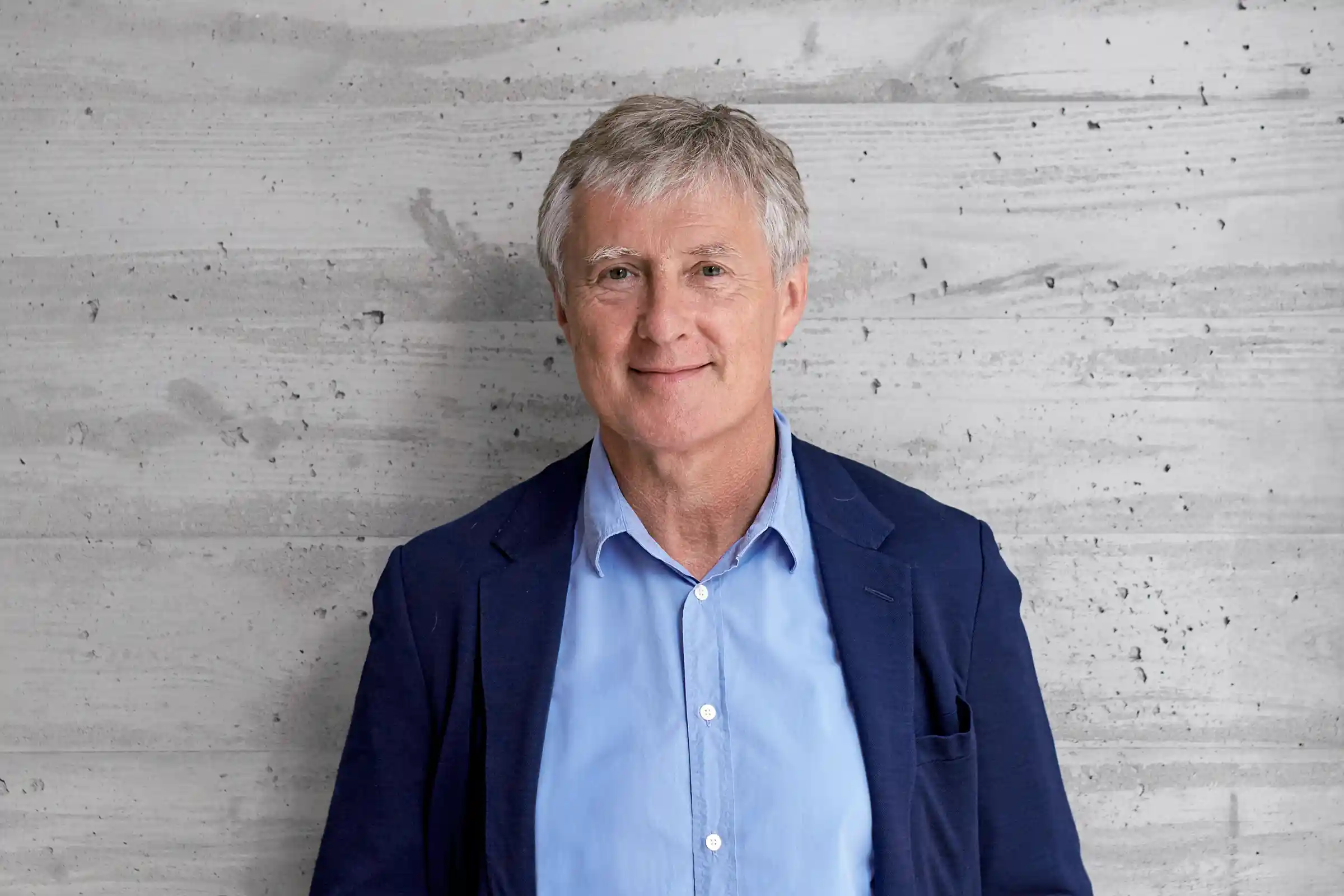
Born in Cologne, Germany, on 23rd October 1964
What impact did the art stars have on you?
They didn’t interest me much. I was a teenager busy doing things teenagers do. I played football at FC Junkersdorf, had piano lessons and was given a set of drums when I got confirmed. One artist who made an impression on me was Joseph Beuys. He had charisma! Whenever an exhibition was launched in the gallery, I often had to run the cloakroom. Mr Beuys would arrive wearing a highly complicated waistcoat with multiple pockets. My job was to help him take it off. I had probably asked him the first few times if I should hang up his hat.
In his autobiography, your father wrote this about you: ‘We never talked about art’.
My recollection is a bit different. At home, we had works hung up on the first floor that my father owned, ones he couldn’t find a buyer for. I can recall some amazing paintings by Cy Twombly, Jasper Johns and Francis Picabia. I would often ask questions about them, which my father would also be happy to answer. Looking back over my teenage years, I would say that it was the art that interested me – the artists rather less so. If you had asked me as a 16-year-old if I would one day want to become an art dealer, I would have laughed and said: ‘No way, that’s much too boring!’
Your father got to know Andy Warhol in 1963 in his studio in New York. Did he try and explain to you why Warhol is a key figure in modern art?
No, he didn’t. However, we did have a significant sculpture by Warhol in our dining room made out of 40 Brillo boxes. When we played hide-and-seek, I always hid behind this sculpture.
You went down your own path very early on. How did your father react when you moved out at the age of 16?
My father was a war baby, who had to become independent very quickly. I think he was glad I flew the nest early. Moving out of home at an early age didn’t really help my school grades, but my digs were very popular with my friends.
In 1993, at the age of 28, you opened your own gallery in New York. Did you experience something like an artistic epiphany in your life?
The initial spark came during my time in Hamburg. I visited galleries and this led me to pay my first studio visits. I felt at home among artists; their world was familiar to me. The key event for my gallery came in 1992 when I visited documenta IX. I got to know the artists Franz West, Luc Tuymans, Stan Douglas and Marlene Dumas, who I later went on to work with.
What are the worst decisions you have made when dealing in artworks?
You shouldn’t haggle if it is a good piece of art. In hindsight, no-one ever regrets the possibility they may have paid a bit over the odds. But it can still annoy you years later when you let something great slip through your fingers because the price seemed a bit too high. The greatest sin of my early years was not buying Martin Kippenberger’s gondola sculpture, ‘Social Crate Transporter’. My good friend Harald Falckenberg was more shrewd and bought the gondola for his collection.
When the curator and long-time museum director Kasper König was asked how long it took him to be able to spot a piece of high-calibre art at exhibitions, he replied: ‘0.1 seconds. When I’m really on it, I can even tell with my eyes closed.’ What’s it like for you?
Unfortunately, spotting great art with my eyes closed is not part of my skillset. Wenn I look at a new work, a process begins in my head that I call pattern recognition. For 99.9 per cent of works, I can quickly spot a known pattern and categorise it. Then I am less interested. For me, alarm bells start ringing when I can’t categorise a piece of work. I then start a detailed analysis of what I am seeing.
Each year, the art market turns over around 68 billion dollars. Critics complain that the demand for art is bigger than the supply, which allows even windbags to have a profitable career
I think four out of five artists traded on the art market today will be forgotten within a generation.
With this prognosis, you’ll disappoint those who see art as an investment with above-average returns.
You’ll have a hard time with us if – when buying the artwork – you are speculating on it increasing in value or wanting to chase the latest fads. We want to see our artists’ works in museums. We are also interested in passionate collectors who examine the works, take a closer look and ask questions. This way of examining artworks can lead to a big growth in value.
There are two types of artist: The pirouette beings, who shift to the markets that are booming at that time, and the God-seekers, who are compelled to go down one specific path. What type are you?
I differ between the art obsessives who can’t do anything different and the entrepreneurial artists, who are very business-minded and shrewd. Their number has increased massively over the last 20 years. The careers of these artists are often short and intense. I am much more interested in the art obsessives, because among them you’ll find the artists who will remain significant over the long term. As well as estates, we represent 56 living artists. Every one of them is an art obsessive. The centre of their lives is the studio. They are starting over again and again and solve problems.
High-calibre artists are often over-sensitive, hypochondriac, totally self-obsessed egocentrics, who oscillate between megalomania and inferiority complexes. How have you endured that for 30 years?
By delegating. It is completely impossible for me to look after all our artists myself. I have wonderful employees who are supremely familiar with the inside of the artists’ souls. They know that insecurity is often the engine for great art. Our task is to give the artists security so they have complete freedom to do their work.
How do you explain the fact that Iwan Wirth, Thaddaeus Ropac and yourself, three of the world’s most significant gallery owners, come from German-speaking countries?
Around the world, people from German-speaking countries are considered to be reliable, and reliability in the art trade is a key characteristic. The wonderful thing about our industry is that, to this day, 99 per cent of all sales are concluded with a handshake or over the phone. And we don’t have any contracts with our artists either. Our working relationship is sealed with a handshake. Nowhere else do you find this relationship of trust. Only with collectors you don’t know very well would you sometimes draw up a purchase contract.
The gallery owner Johann König from Berlin wrote in his autobiography: ‘The art world is built on excess; that is part of its DNA and forms the basic understanding of almost all those operating in it. Every other person seems to have drugs in their pocket.’ The painter Georg Baselitz put it in a similar way: ‘If you don’t drink and aren’t mad, if you don’t stand out in your social circle, you won’t get on in the art world.’
What rubbish! 40, 50 years ago that may have been true. Martin Kippenberger and Jackson Pollock were both brilliant artists and alcoholics. For journalists, it is of course compelling when Jean-Michel Basquiat dies of a drug overdose at the age of 27, but the creative process in the studio has nothing to do with all of that. I know many significant artists who don’t drink much, if any, alcohol.
That includes Jeff Koons, who in May this year explained at a digital fair in Hamburg how he eats precisely 48 pistachios per day, as instructed by his nutritional advisor. A compulsive character?
You have to exercise extreme caution with Jeff’s assessment. I have worked with him for a long time and know him very well. Not only is he a truly exceptional artist, he is also a unique type of person. His personality type continues to puzzle me. He is as elusive as quicksilver. Many artists are introverts and don’t have the talent to present themselves in public. Jeff is different. He is a brilliant communicator and has the personality of an entertainer. When he presents his works to collectors and talks about art history and philosophy, he behaves like a guru.
Suppose, hypothetically, you visit one of your artists in their studio and you don’t like what you see: Do you say it to the artist’s face or do you delegate that task to a subordinate?
Studio visits like these can be very tricky. Artists are often fragile and so you need to be very sensitive with your communication. I first ask questions so I know I haven’t misunderstood the works. It can be that I don’t like the works initially, but then I do. I am disappointed when I first look at it because it isn’t what I expected. Two hours later, I can suddenly get excited because I’ve grasped the fact that the artist has chosen to go in a new and exciting direction.
The art dealer Max Hetzler from Cologne once summarised his professional experience by saying: ‘Large picture, lots of dough; small picture, nothing comes in.’ Is this equation still correct?
Yes, if we pick up a painting from one of our artists at their studio, we usually set the price based on square centimetres – which is completely mad – but no one has come up with a better standard for the primary market. The secondary market works differently. There, it is quality that governs and determines the price.
Is it true that paintings larger than 2.40 metres are harder to sell because they don’t fit into the New York elevators?
Yes, we had this problem 30 years ago and elevators in New York have not really got any bigger since then. The difference is that clients are richer now than they were back then. Most of them have several properties. If a painting doesn’t fit into their apartment at Central Park, it can be hung up in their villa on Long Island or in Florida.
When people talk to you, there is a white elephant in the room: Larry Gagosian – risen from poster seller in Los Angeles to become the most influential dealer in the history of art and pioneer of the so-called mega gallery. Who is, in terms of turnover, the current number one in the world, Gagosian or yourself?
The numbers are not made public, but I suspect it fluctuates. In a good year, we can be out in front, another year it’ll be Gagosian. For me, the quality of the artists you represent, and the quality of the exhibitions you put on are much more important than annual turnover.
Gagosian was asked in an interview in 2019 if the gigantism of the art industry will last. He replied: ‘With basketball players, they say anyone over 2.10 metres is no good anymore.’ What is the current marker for the art market?
The art market has been growing organically for 30 years. New growth drivers include, for example, South Korea and India. There is still huge potential for growth because the number of affluent people interested in art continues to increase worldwide. Another issue is how big a gallery can be until it no longer functions properly. Today, we represent 85 artists and artists’ estates. That is already pushing it, but actually, with our infrastructure, we could probably be supporting 100 careers. Any more and we wouldn’t be able to give the artists the service they deserve.
Gagosian owns a private art collection worth more than one billion dollars, employs a butler called Eddie and flies around in a Bombardier Global 7500 – a private jet that costs around 60 million US dollars. What are your insignia?
My phone is enough for me – and I can operate it without needing a butler. I have put most of my profit from the last 30 years into real estate and our warehouse. Some of the buildings where we organise exhibitions I bought or built myself. And there are some wonderful works in our warehouse.
Whenever you’ve been asked if you own a private art collection, you have always answered ‘No’. Is that still true?
No, what I have hanging up on my walls at home has since become a bit of a collection. These paintings are also not for sale, because I love them. The ones closest to my heart are two grey Date Paintings by the Japanese conceptual artist On Kawara, one from the sixties, one from the eighties.
A doctrine from Gagosian is: ‘The more you pay for a work, the more likely it is that your investment will retain its value.’ That’s not something an amateur would understand.
It’s the same in the real estate industry: location, location, location! The most expensive painting can always become more expensive if it is an icon with an extremely high recognition value.
In his book ‘Boom: Mad Money, Mega Dealers, and the Rise of Contemporary Art’, the US journalist Michael Shnayerson describes the relationship between Gagosian and yourself as a ‘cold war’. You were more diplomatic when you said you had ‘never broken bread together’.
My relationship to Gagosian has always been misunderstood. I don’t wake up in the morning wanting to bring down the Gagosian empire. That we are personal enemies? That’s just rubbish. I have a great deal of respect for him. His gallery is doing some fantastic work. We don’t get on personally, but I suspect we are very different characters.
Insider trading, price manipulation, cartelisation: things that might otherwise land you in prison are seemingly common practice on the art market. Will you get through the gates of heaven?
Actually, the question is, where would you have more fun? All alone with Leo Castelli in heaven or in hell, with lots of hilarious ‘problem cases’ from our industry? The claim that art dealing is a semi-criminal organisation is utter nonsense. It’s like anywhere: if you work with the wrong sort, you can have a bad experience. That’s why reputation and renown in our industry are so important.
You have been working with the architect Annabelle Selldorf for over 20 years. This is what she has said about you: ‘You wouldn’t really call David laid-back.’ What mark would you give yourself in the art of living?
A three. I wouldn’t sit opposite you now if I wasn’t a hard worker. Leo Castelli closed his gallery in June and would open it back up again in September. You can’t do that anymore these days. I opt out for the whole of August. We have a house in Montauk on Long Island where we put other things on the agenda: family, reading, swimming, surfing. When I come back to work in September, I see things much clearer and I make changes that I wouldn’t have thought necessary had I not taken the month off. A colleague once said to me: ‘Not working in the summer is your secret superpower.’
What are the downsides of your job?
The brutal amount of travelling. Recently, I had a week in which I was first in Cologne with Gerhard Richter, then Düsseldorf, Paris, Tokyo and Kyoto.
What did you do in Kyoto?
I organised a lifelong dream for Elizabeth Peyton: an exhibition of her artwork in a Buddhist temple. Afterwards, I visited the wonderful Yayoi Kusama in Tokyo. She is probably the most successful female artist in the world.
You share a chequered history with the Austrian Franz West, who died in 2012 following cirrhosis of the liver and Hepatitis C. He was the first artist you exhibited in 1993. He switched to Gagosian in 2001. Today, you represent part of his estate.
Franz always had a colourful entourage around him made up of old aristocracy, starvelings and hedonists. I particularly liked Ron, the tuba player in the Vienna Philharmonic. At dinner after an exhibition launch, he was hidden away by Franz in an adjacent room in order to then strike up completely unexpectedly. The tuba sent shivers down our spines.
Which phrase in your industry would you like to ban the most?
The term mega gallery. I know we are one, but for me, the term sounds common, like it’s a shopping mall.
The sculptor Alberto Giacometti was once asked what he would save from a burning house: a cat or a Rembrandt. He went without hesitation for the cat.
That is a trick question. I am allergic to cats and so I would save the Rembrandt.
Sven Michaelsen
met David Zwirner in his office in New York’s gallery district, Chelsea. On the walls hung a Gerhard Richter and a Piet Mondrian. ‘Don’t get the wrong idea about my need to show off,’ said Zwirner. ‘Both paintings are for sale.’