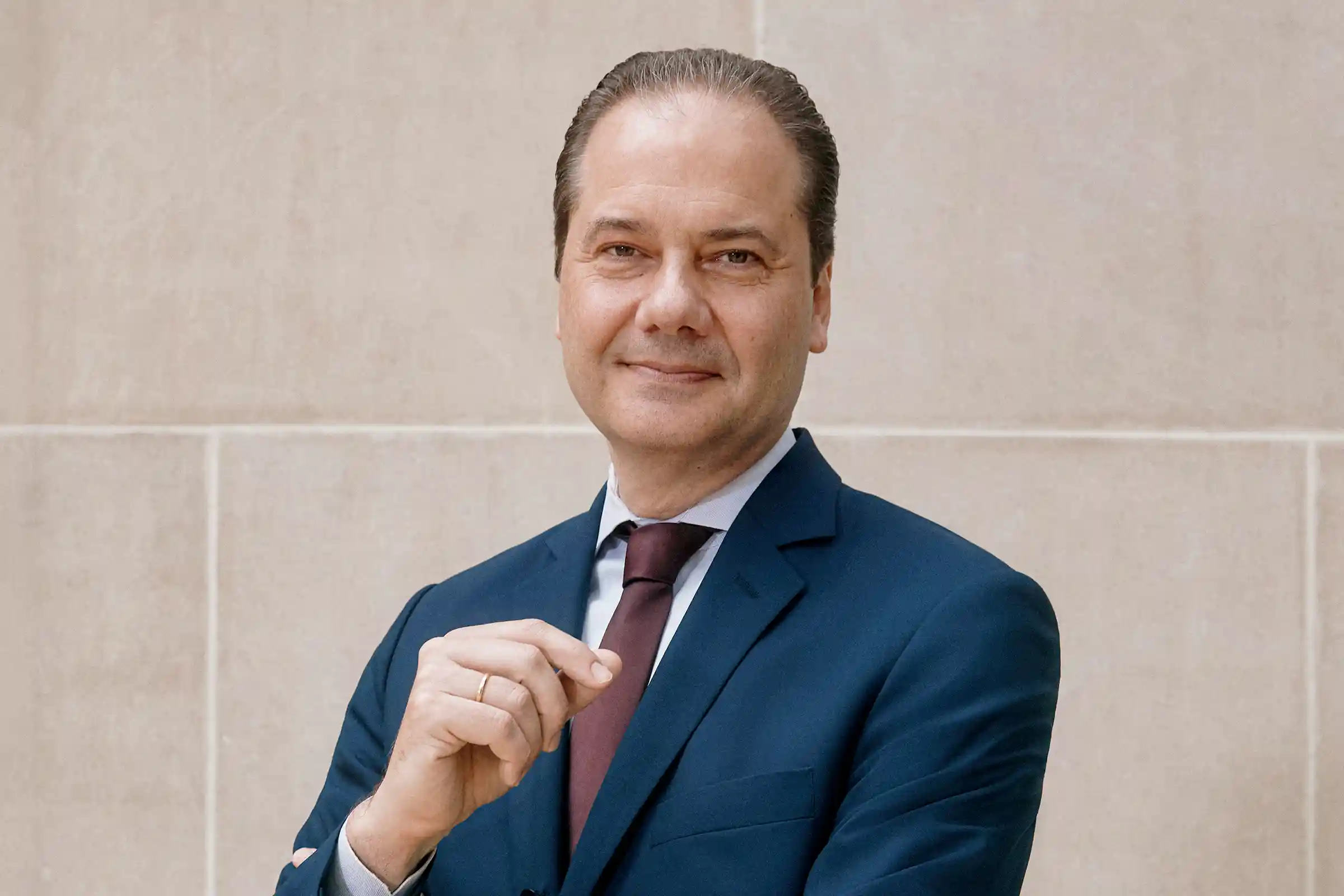
Your father, who died in 2014, was the avant-garde architect and artist Hans Hollein, who designed nine museums and in 1990 sparked fierce public protests following his post-modern design of Haas Haus opposite Vienna’s St. Stephen’s Cathedral.
As soon as I had learnt to walk, my father took me with him to every museum on his way. I’ve been running museums for 25 years. In that respect, my life hasn’t changed all that much.
Did you enjoy going to museums as a child?
I went sometimes, but the visits did give me an information advantage. In primary school, we had to give a presentation about an artist of our choice. Most chose van Gogh or Monet. My subject was the Russian constructivists Naum Gabo and Anton Pevsner. It wasn’t me showing off. The art from these two was just what I, as a nine-year-old, was most interested in.
'If asked, he would also sign the décolletage and backs of ladies of Viennese high society.'
Which museum visit during your childhood made the biggest impression on you?
In 1980, Andy Warhol came to Vienna for a large exhibition of his work. My father knew him and took me with him. Warhol sat there in silence and signed everything that was put in front of him with an impassive face. Aged eleven, I was really impressed by the performative aspects of his appearance, because, if asked, he would also sign the décolletage and backs of ladies of Viennese high society. An artist quickly fetched a piece of his own work from the studio and placed it in front of Warhol. He didn’t hesitate a moment before signing the work. I might well have been part of the performance, without knowing it: not only did I get the front cover of the exhibition catalogue signed, I got every single page in it signed too. Once Warhol had signed a page, I would go and join the back of the queue again. My serial queuing lasted about two hours. At one point, I plucked up the courage and, with my limited knowledge of English, asked: ‘Could you sign “for Max”, please?’ Without the artist looking up, I got my dedication. I cherish that 16-page catalogue to this day.
Your father was obsessed by his own work. Did it hurt you as a child that it appears there was something more important in his life than you?
It wasn’t that our family had to constantly admire our father’s new buildings, but all our lives were organised around his work. I can still remember the times now when the school broke up for the summer. I envied the children whose parents were sat waiting for them outside the school gates with an inflatable boat strapped to the roof of their car, making sure they didn’t waste a second of the holidays. That was also what I longed to do – in my head – but the reality was that my family would often wait at home, on standby, bags packed at the ready. We didn’t know when we would go, where we would go or actually whether we would even go anywhere at all. Once, we waited four days for my father because some architecture competition still had to be completed. There were several occasions when he wanted to follow on but then never made it. I didn’t suffer because of it, but as I grew older I realised what priorities an artist has to set for their work. You won’t get very far unless you are a bit obsessed.
Art stars such as Joseph Beuys, Claes Oldenburg and James Rosenquist socialised with you at home. How did you perceive these people through your child’s eyes?
My parents’ friendship circle was made up exclusively of artists and actors. They enjoyed good food and drink and partied a lot. Now and then someone would dance on the table or scribble messages on the walls in our toilet. They were loud and pugnacious. My father ranted and raved too. I used to think, they won’t talk to each other ever again, but the next day everything was fine again.
Have you had anything like an artistic awakening in your life?
Yes, my first encounter with the works of Francis Bacon. I was 15 or 16 and understood that art doesn’t have to be nice or bring you joy. The bleakness, melancholy and aggressiveness of his paintings stirred something in me. It was a power that I had never felt before.
Why, despite his fame, did your father constantly have money problems?
The Hollein studio had up to 30 employees. The name said it all. It wasn’t about running a profitable architecture firm; rather it was about artistic and creative drive, and uncompromising perfectionism. You would never have been able to attract him with money to accept a trivial job. He and his colleagues could spend years fine-tuning plans for a small but architecturally revolutionary retail store in Vienna. In the end, the fee barely covered ten per cent of the wage costs. This is why there were some years when he had financial problems. His business plan consisted of a mere single sentence: ‘At some point, it’ll work out.'
In Germany, your father designed, among other things, the Museum for Modern Art in Frankfurt, which opened in 1991, and the Austrian Embassy in Berlin, completed in 2001.
He certainly didn’t get rich from them either. I remember magazines including ‘Architectural Digest’ pressing him to photograph our home. They told us it would be interesting for readers to experience how Austria’s most famous architect lives in his private life. Our mother took on the job of turning down such requests, always saying the same thing: ‘You wouldn’t be impressed. We live in a rented flat where my husband’s mother lived.’ My father would often imagine how his private home could look. But he wasn’t interested in actually building it.
Your parents would have liked to have seen you become an artist. However, aged eight, you were thinking up games that involved money-making, and when your parents visited art exhibitions abroad, you stayed in the hotel and swotted up on the Basic computer language. Was it your nature to rebel against the father figure?
The word ‘rebellion’ is too dramatic. It was more that I first thought, at the age of 14, that my parents should be more interested in business administration. Because they didn’t do it, I did it and studied both business administration and art history at the same time. Alongside that, I worked freelance in the business editorial team at the ‘Der Standard’ daily newspaper.
After completing your studies, you did an internship at the Solomon R. Guggenheim Museum in New York. From 1996 onwards, you became like a foster son to the legendary director Thomas Krens and took part in founding the Guggenheim branch in Bilbao in Spain, designed by Frank Gehry.
The choreography, which is what Krens used to portray his radical ideas, was exceptionally impressive. From the moment he set up his office, he showed visitors how important he was and what an incredible feeling for aesthetics he had. He combined two trigger points, which I found highly attractive: he was on the one hand an artistic visionary; on the other a shrewd business leader.
Your contract stipulated an annual salary of 25,000 dollars. Why did Krens increase your salary five-fold after just six months?
Although I had just turned 25 and was still relatively inexperienced, he promoted me initially to be his assistant and then to higher-up positions. He knew why: I have never worked so hard in my life as I did in those six years working under him. I was all in and was available to him 24/7. I was with him at his home at Christmas and spent Thanksgiving with him. It was exciting and totalitarian all at the same time. Hard to believe, but it’s true: in my current position, my days are significantly shorter.
Which three adjectives describe Krens’ leadership style?
Fearless, charismatic, but also pharaonic. I was very quick to grasp how he saw things and how to translate what he wanted both internally and externally. That is why he made me his extended arm.
Krens is said to have an XXL ego. What was the essence of his capabilities?
His instinct for what we would call the window of opportunity. He was an absolute gambler and had nerves of steel. If someone wanted the same thing as him, he would immediately double his commitment. Watching him win and come unstuck was game-changing for me. Nobody thought bigger than him. The Guggenheim Museum Bilbao, the Louvre Abu Dhabi and the Guggenheim Abu Dhabi would have never come into being had it not been for him.
Krens is 79 years old. What was the biggest lesson you learnt from him?
Never behave like a beggar, even to large donors, where there is a lot at stake. A ‘No’ from the other party means, at most, that they have just not understood the question properly and you can immediately continue negotiating with them. This ‘I’m gonna get this’ attitude had a big impact on me. The Viennese in me would otherwise constantly project the whole thing coming to nothing anyway.
When you resigned from Guggenheim, you apparently said to Krens: ‘I have to leave here because I risk becoming a copy of you.’
That was the sentence. For me, Krens was not just a dominant mentor, he’d almost become a second father figure to me. If I hadn’t broken away from him, I would have become a miniature version of him, repeating everything he said like a parrot. The move away from Vienna was for similar reasons. I wanted to step away from the shadow of my famous father and find my own path.
How did Krens take your resignation?
With total incomprehension, initially. He said, I was his predestined successor, so it was crazy to leave the Guggenheim and move from the global metropolis of New York to Frankfurt am Main. Over the following years he tried to get me to go back to him several times: in his typical fashion – do not take no for an answer!
In 2001, you became Director of the Schirn Kunsthalle in Frankfurt; from 2006 to 2016 you also managed the Städel Museum and the Liebighaus Skulpturensammlung (Liebighaus Sculpture Collection). In 2016, you were Director of the Fine Art Museums of San Francisco for two years. Since 2018, you’ve been Director of the Metropolitan Museum of Art in New York, known as the Met in the art world. How would you describe your leadership style?
At first glance, I come across to many as a cool, pragmatic numbers person with impeccable manners. If you get to know me a bit more, you’d notice that I am drawn to risk, radicalism and an experimental, artistic approach. I am the opposite of a technocratic director – although I’m good at outwardly portraying this type of person.
Along with the Louvre in Paris and the Prado in Madrid, the Met is one of the three most important museums in the world. How do artists react when they come face to face with the Met Director?
Visiting studios and galleries is part of my wife’s and my life. The unfortunate thing is that my appearance sometimes raises expectations that cannot be met, even among artist friends who I’ve known for a long time. When it comes to purchases or projects at the Met, I have become (in the eyes of many) a gatekeeper – that is a precarious position. It’s probably easy for them and me to agree on a hundred living artists who deserve to be exhibited right away at the Met. The reality, however, is that over the coming ten years, only about five of them will be exhibited because our programme covers many centuries. So that’s 95 artists who will potentially feel disappointed, offended or devalued by me.
Do an artist’s prices increase when they publish a photo on Instagram showing you in their studio?
Yes, sometimes. It’s a signal to the art market at the very least. I try to avoid those photos.
Most of the time you wear a suit and a tie. Is it true that lots of Met visitors ask you the way to the toilets because your clothes make them think you are a museum attendant?
Yes. I am also asked in Prado where the toilets are. I know the answer in Prado. It’s embarrassing in museums where I don’t know. I then have to explain that I am not a member of staff.
Your wife, Nina Hollein, was an architect in the offices of Peter Eisenman and Albert Speer and worked for Tod Williams and Billie Tsien’s architecture firm in New York. Since 2009, she has run a fashion label for women under her own name. When it comes to clothes, you both look as if you live on two separate, far-away planets.
I assume you mean that as a compliment to my wife on her style and as a prompt to me to make more of an effort when it comes to my fashion choices. I admire Nina not just as a highly creative designer, but also for her own sense of style. To her, I probably come across as an assimilated, reasonably elegant square. However, wearing clothes that can’t be clearly categorised does have its advantages. As Director of the Met, I am in very close contact with leaders in the finance and economic world. These people appreciate it when the person sitting opposite them is not too colourful a personality.
The Met is a private foundation with assets of 5.4 billion dollars. According to the Articles of Association, you are permitted to spend 40 million dollars of this money this year on new purchases – a laughably small amount given the prices on the art market.
For European museums, that would be a very tidy sum. In the case of new purchases, the Met lives mostly off donations from our patrons. In terms of expanding the collection, we are one of the world’s most active museums.
What was the value of the gifts received over the last three years?
We’re talking in the billions.
The pop singer Madonna is believed to have an art collection, from masters of the Middle Ages to Picasso, Dalí and Frida Kahlo. Do you try and get people like her to make donations or do you expect them to come to you?
We are extremely proactive and strategic. Our curators and researchers monitor closely which collectors buy what and whether their heirs are currently looking to link up with a museum. I visit some collectors five or six times. In the first meeting, I talk about how vitally important individual works of art on the walls are. At some point I will then say, very gently, how splendid it would be to bring a couple of these pieces together in a dialogue with our works of art. It is a long dance, but these discovered works do generally come to the Met and thus into the public view. With other collectors, I get through the door on my first visit, fully prepared, point straight to a painting and say seemingly off-the-cuff: ‘You know, this work, we need it at the Met. You should give it to us.’ The personality of the collector is what dictates my approach. It sometimes helps that I can easily switch between the brash New York style and the somewhat polished manners of Vienna.
When do your acquisitions get tricky?
We are very often offered donations that we don’t want. These offers frequently come from people who have been financially supporting the Met for many years – very proudly waiting for the day they’ll see their pieces there. It takes tact and sensitivity for such situations to not end in permanent separation.
The steel tycoon, Andrew Carnegie, who died in 1919, donated almost 80 billion dollars by today’s reckoning. He is still remembered because he paid for the construction of the Carnegie Hall in New York, which was named after him. Is the seeming immortality of their own name what drives these major donors?
We also get anonymous large donations. Patrons are motivated by any number of different things: from public recognition for exemplary behaviour to fantasies about eternity or a guilty conscience they want to ease. Giving back to society is part of American culture. A famous quote from Andrew Carnegie goes: ‘The man who dies rich dies disgraced.’
The largest individual donation in the history of the Met was 145 million dollars. It came from the billionaire Oscar L. Tang and his wife H. M. Agnes Hsu-Tang.
Their donation contributed to the funding of a five-storey extension for art from the 20th and 21st centuries, which will be ready in four years’ time. Total costs for the project will amount to around 650 million dollars.
Where will the missing 505 million dollars come from?
From a number of other patrons.
Tang, who was born in China but became rich from asset management in the USA, is turning 90. What was his reason?
For a long time now, he’s been one of our major donors wanting to remain under the radar. During COVID, rumours circulated that the virus came from a laboratory in China. In the USA, this led to hate crimes against people who looked Asian. During this time, Oscar and Agnes asked me what they could do to make members of the public realise what impact Asians had had on the development of the USA. It needed to be very charismatic and visible. Our plan – to build a new wing for modern and contemporary art – was still in its infancy back then. They thought, that’s it!
The extension will bear the names Oscar L. Tang and H. M. Agnes Hsu-Tang Wing.
My impression is that, for both of them, this isn’t about immortalising their names. Rather, for the 25 million Americans of Asian descent, it is intended to be more of a symbol of their importance. The Met was founded for similar reasons: an emerging global city wanted to demonstrate its new importance with a cultural landmark. In 1866, a group of citizens from New York visited the Louvre in Paris. Showing the typical American ‘can-do’ mentality, they said at the end of the tour: We need something like this in our city too! They didn’t have a building or a single piece of artwork for their crazy plan. They also had to first find some supporters to raise the necessary funds. The Met was founded just four years later.
Your most recent exhibition shows more than 170 works by the Renaissance artist Raffael. The show’s ‘presenting sponsor’ is the investment bank Morgan Stanley, followed by 36 other sponsors. A Marxist might now ask whether you are a lackey for high finance, dependent on plutocrats wanting favour as patrons of the arts.
Anyone giving money will want to have a say about what is done with the money. There are many people sitting on our administrative board who have important art collections. I can understand that a hedge-fund billionaire who collects Asian art will push for us to purchase and exhibit Asian art as often as possible. My job is to bring together the sponsors’ many individual interests to produce a through-composed concert. The more funding sources we have, the more independent I am as the conductor.
The most expensive painting in the world is Salvator Mundi, which most attribute to Leonardo da Vinci or his workshop. In 2017, the painting was auctioned for 450 million dollars – the buyer was Saudi Crown Prince Mohammed bin Salman. If you had been its director at that time, would you have bought it for the Met with the help of major donors?
In 2017, three of the world’s leading da Vinci experts were working at the Met and they just couldn’t agree as to what the painting was. That’s the answer to your question.
In March 2018, six months before you took over the Met, the photo artist Nan Goldin appeared in the Met with around one hundred activists and protested against donations given by the Sackler family of entrepreneurs, who made a fortune from the painkiller Oxycontin, which was jointly responsible for the opioid crisis in the USA. Did your predecessors ‘accept blood money from drug dealers’, as Goldin says?
Nan Goldin is a key voice and art is often a seismograph for much-needed change. In May 2019, we announced that we would no longer take any money from the Sacklers. Two years later, the decision was made together with the family that the Sackler wing, which was opened in 1978, would no longer bear their name.
The Met is the largest museum in the USA: two million artefacts spanning 5,000 years of history, hundreds of rooms that, put together, make up 186,000 square metres of space, 1,900 employees, more than 1,000 voluntary helpers, curators from 70 countries, six million visitors each year. How did you become its director?
Initially there were three informal preliminary discussions with everyday questions such as ‘How do you think the Met is doing?’ It was done as if I was an adviser being asked for a non-binding opinion. The fact that we were in discussions about the job was kept top secret. At the meeting where they made the final decision, I had 40 curator members sat opposite me along a huge table.
Did you sleep well the night before?
Yes. At my first press conference as Director of the Schirn Kunsthalle, I was 31 years old and quite nervous, but since then I’ve learnt how to circumvent the Masters of the Universe. One curator member at the Met asked me to tell him something about the museum he didn’t know yet. Instead of cleverly finessing about Antoine Watteau or Rogier van der Weyden, I replied: ‘What you don’t know is that 50 per cent of the pieces in the Met don’t tell the truth; instead they spread propaganda. The paintings by Lukas Cranach, for example, are an advert for Luther. We need to bring this context to life for future visitors.’
At what point did you know you had got the job?
The last step was the request to meet my wife. I said to her: ‘It’s getting serious now. They want to see if you are socially acceptable.’ There were then two breakfast meetings, two lunches and two dinners. And that was that.
In all its 156-year history, the Met has never been run by a woman. Did you have a rival female candidate in your candidacy for Director?
I know of two, because they spoke to me after I was selected. There’s a high chance a woman will run the Met after me.
Born into an aristocratic family in France, Philippe de Montebello ran the Met from 1977 to 2008, longer than any other. If you want to do the same as him, you would have to stay in your post until 2049 and would then be 80 years old. Is that your goal?
My job makes me unbelievably happy. In that respect, I assume I’ll be running this museum for a long time to come.
Your contract is permanent. Will you one day be carried out of the Met feet first?
The Board of Trustees thinks that I am getting close to this scenario, or that I’ll be here until the end of my career at least. However, it does say in my contract that I can be fired at any time.
In its 207-year history, Prado has always been run by a Spaniard; in its 233-year history, the Louvre has always been run by a Frenchman. Without the Met, it’s only downhill for you from here.
I don’t spare any thoughts about going downhill. I see the Met as my life’s work and cannot imagine holding any other position.
Anyone running a large museum in Germany earns around 100,000 euros per annum. Your salary is 1.7 million dollars, financed since 2021 by two foundations. Since you took over the Met, have you been offered any better-paid jobs?
Yes, I have been approached, particularly from founders of companies working at the interface between the art market and digital technologies.
Alongside an appreciation of art, you are also said to have excellent management qualities. Could you also run a burger chain?
I could, but it would break me emotionally.
What are you absolutely no good at?
Playing football.
What is your most ridiculous ambition?
To arrive ahead of schedule. Much to the displeasure of my wife. Shortly after we got together in our student days, this ambition of mine came within a whisker of costing us our relationship. We wanted to go to a techno rave in an old underground station in Vienna. Because of me, we were the first two guests to arrive at the huge venue. Since then, my wife is the one who decides when we show up at parties.
Suppose, hypothetically, the Met was on fire, which three pieces would you save?
It’s true I’m not afraid of making decisions; however, I wouldn’t be able to respond to this horrifying prospect. I fear I would burn up together with all the works in our museum.
In your office, you can see paintings by Lee Krasner, Helen Frankenthaler, Philip Guston and Jackson Pollock as well as a Chola sculpture from India and the stone head of a female Egyptian god...
...it all belongs to the museum!
What do you have hanging up on your walls at home?
Nothing from the art scene; instead I have artworks by my friends and by artists who have had something to do with my wife’s and my life story. The painter Christian Ludwig Attersee, for example, was a close friend of my parents – I’ve known him ever since I was a child. We bought a few of his early works at auctions. We also have some lovely works by Walter Pichler, Daniel Spoerri, Eugene Leroy, Enrico Baj and Michael Langer, a painter from the ‘60s who has since been forgotten. And, of course, one or two other drawings by Hans Hollein.
Can you also still love a piece of art after discovering the creator was a monster?
Yes. If you can’t separate the work and morality of an artist, you’d have to disregard half of art history.
Would the number of visitors halve if they had to hand in their smartphones upon entering the Met?
Yes, and not just because you wouldn’t then be able to take any souvenir photos, but because the connotations of imposing a mobile phone ban are that the Met is not in step with modern times. We want to be a museum that lives in our time, rather than simply reliving old times. The art of the past can reveal to us something about the present.
You’ve been running museums for a quarter of a century now and should therefore know this: Is the museum shop more important to the average visitor than the art exhibits on display?
That is often what’s claimed, but there’s no evidence for this theory. We are currently reducing the floor space in our museum shops because we want to focus on the power of art, which you can experience with us. Attention span for cinema, TV and newspapers has been falling for years. However, the length of a visit to a museum has remained the same.
How long does the average visitor stay at the Met?
Two hours and 49 minutes; the trend is actually moving slightly upward, which is a reason to feel optimistic.
The Met is a universal museum, whose collection also includes weapons, musical instruments, samurai armour, more than 35,000 pieces of clothing and accessories, an Egyptian temple from pre-Christian times and more than 30,000 historic baseball cards. Suppose, hypothetically, you guided a newbie through the Met and all you knew was that they had two hours and 49 minutes: Which of the 17 departments would you include in your tour?
The person I have in my head would stroll through our rooms with an open mind, like a contemporary of Marcel Proust. Rather than going down the same old paths, they want to make discoveries; they want to be surprised and are prepared to cast aside any preconceived ideas they may have had about what they are seeing.
How is the culture war of Donald Trump affecting the Met?
Trump has changed the mood across the whole world, but we are a private foundation. There has been no attempt by politicians to influence our programme. The big change since Trump is that our exhibitions are being interpreted in a much more political way. Last year we had the Superfine: Tailoring Black Style exhibition. It showed how fashion has influenced the identity of black people for 300 years. Many people thought that the show was our response to Trump. The truth is, we started planning it in 2022 when the Democrat Joe Biden was in power. Up until recently, our The Met Cloisters branch held an exhibition called Spectrum of Desire: Love, Sex, and Gender in the Middle Ages. Based on the latest research findings, the exhibition showed concepts of gender fluidity in the Middle Ages. Many took this topic to be our protest against Trump’s anti-LGBTQ decrees. In February 2025, we opened the first comprehensive exhibition of Caspar David Friedrich in the USA. Trump’s second presidency had begun one month before that. This coincidence in timing was interpreted as escapism: romantic landscape painting instead confronting the present. The narrowing of the perspective on current political discourse is not in line with our basic stance. We exhibited Caspar David Friedrich because we love his paintings.
In 2020, you declared the Met’s commitment to diversity and appointed a Chief Diversity Officer. Trump thinks such programmes are despotism and make a mockery of the principle of merit. Has the post since been abolished due to anticipatory obedience?
No, we will continue to have this position.
Your father and your wife were architects; your mother, Helene Hollein, was a fashion designer; your sister, Lilli Hollein, is co-founder of the Vienna Design Week and has been General Director of the Museum of Applied Arts in Vienna since 2021. What careers are your daughter and two sons drawn to?
Our daughter is studying luxury industry management at the Institut Français de la Mode in Paris. Our youngest son is studying the same subjects I studied – business management and art history – in Vienna. Our oldest son is at college in the USA and is specialising in marketing and digital design.
As a Viennese man, you must have an affinity for the Viennese dry wit. Are you one of those people who use the word ‘interesting’ at art parties or high society evenings to mean ‘interesting that you find something so uninteresting interesting’?
I have dialled my humour right down because many Americans don’t get this special type of humour and the potential for misunderstanding is very high. I save the dark humour and irony for when I am back staying in Vienna. As soon as I hear the taxi driver on the way from the airport to the city, I feel completely back at home again.
Sven Michaelsen
spoke with Max Hollein in his Director’s office on the fifth floor, which leads to a roof terrace with a panoramic view over Central Park. In the entrance hall of the Met, he noticed metre-high flower arrangements, which no German museum can afford. The explanation was given on the Museum’s website: In 1967, Lila Acheson Wallace, co-founder of the Reader's Digest magazine, set up a multi-million dollar endowment to pay ‘in perpetuity’ for these weekly flower arrangements, as stipulated in the Articles of Association. In return, a wing of the museum was named after her.